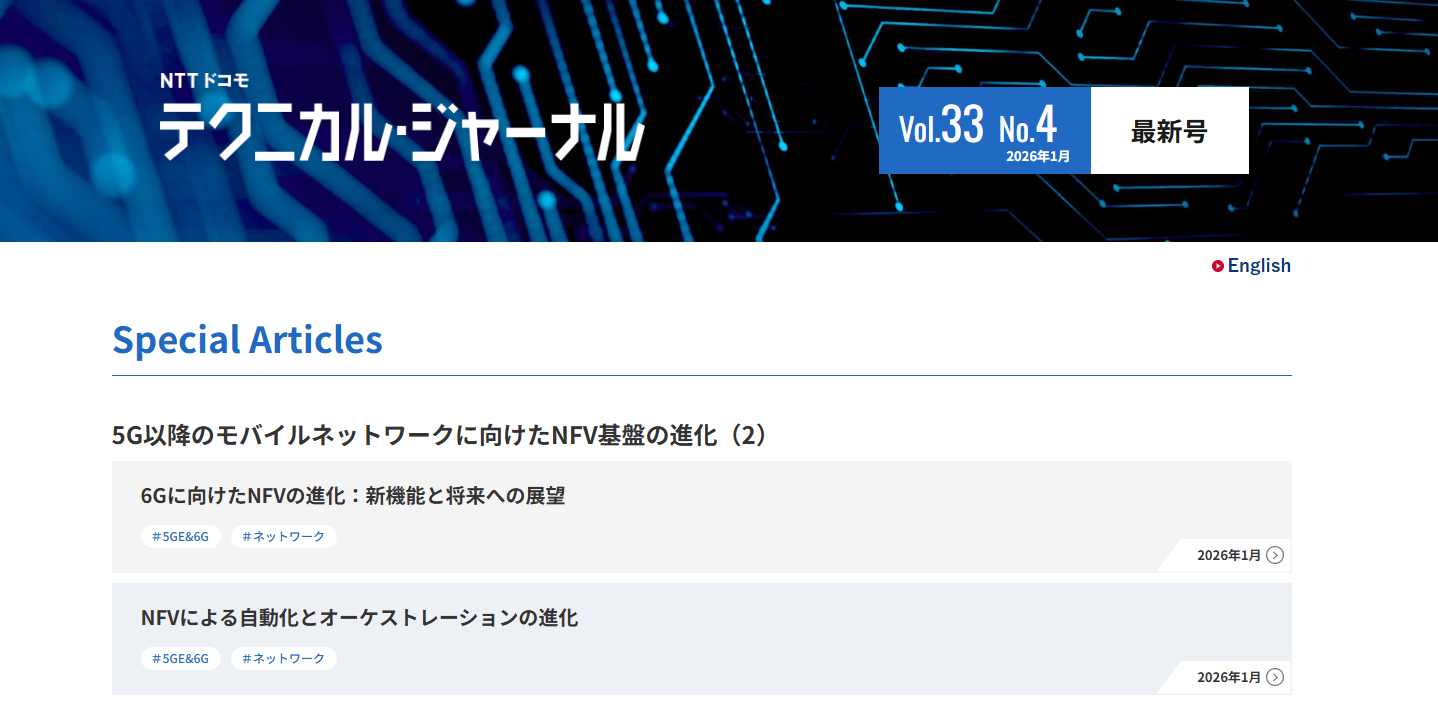
DOCOMO’s Technical Journal (DTJ) issue in January 2026 includes second round of dedicated NFV-related articles, which have been edited and led by contributors at DOCOMO Euro-Labs.
DOCOMO’s Technical Journal (DTJ) (https://www.docomo.ne.jp/corporate/technology/rd/technical_journal/) is an online published journal which showcases the most recent and impactful R&D outcomes from NTT DOCOMO. As part of the January 2026 issue, additional NFV-related articles have been published, to which DOCOMO Euro-Labs members have actively contributed. These articles are in addition to the ones published in the previous October 2025 issue (see here: https://docomolab-euro.com/en/nfv-series-articles-published-on-docomos-technical-journal/).
The first article, co-authored by Dr. Kostas Katsalis, Dr. Refik Fatih Üstok, Bertrand Souville (from DOCOMO Euro-Labs), Yuya Kuno (concurrent position at DOCOMO Euro-Labs and NTT DOCOMO, INC) and Dr. Yoshihiro Nakajima (from SDD at NTT DOCOMO, INC) and titled “Evolving Automation and Orchestration with NFV” exposes the mechanisms in place and empowered by NFV regarding automation and orchestration. As remarked in the article, the continuous technological evolution of NFV through standards and open-source solutions, such as the introduction of machine learning, artificial intelligence, closed-loop, statistical analysis, and intent-driven operations, will make mobile networks more economical and operational efficient.
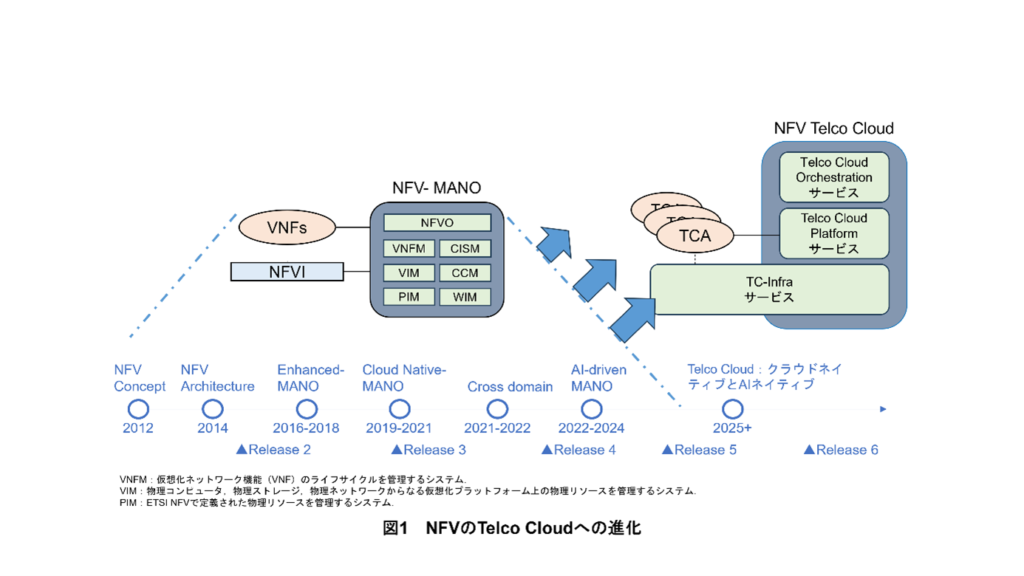
The second article entitled “NFV Evolution for 6G: New Features and Future Prospects”, co-authored by Dr. Afaf Arfaoui, Dr. Joan Triay (at DOCOMO Euro-Labs), as well as Dr. Katsalis, Yuya Kuno and Dr. Nakajima focuses on the evolution of NFV as a unified platform for 6G. The article describes the evolution of NFV, including new infrastructures such as non-terrestrial network (NTN) devices and public clouds, in-network computing that utilizes compute resources within mobile networks to run AI/ML, which is expected to be a new use case, and new virtualization technologies beyond VMs and containers.
The articles can be accessed online on the respective links. As in previous releases, please note that, currently, the articles are only published in Japanese. In case you cannot read Japanese, commonly used web browsers provide features to translate websites, hence there’s nothing stopping you to read them! Go ahead!
Link to the published articles: